Human beings and their needs are the focus of all efforts in transportation research, policy making, and of RA A. We need to understand the travelers’ and non-travelers’ preferences and behaviors in order to be responsive and to shape future transportation systems that meet those preferences in a responsible way. Empirical projects in RA A enhance quantitative data collection methods for revealed and stated behavior and preferences (RP and SP). We also advance methods from statistics and machine learning to exploit the potential of new data sources for characterizing and modeling travel and traffic patterns. Activity-based models are developed to address the currently insufficient consideration of the active modes walking and cycling in these models. We also investigate how well a Deep Reinforcement Learning (DRL) agent can learn to make effective mode choice decisions.
A
A1
Innovative survey designs for better understanding human (travel) behavior
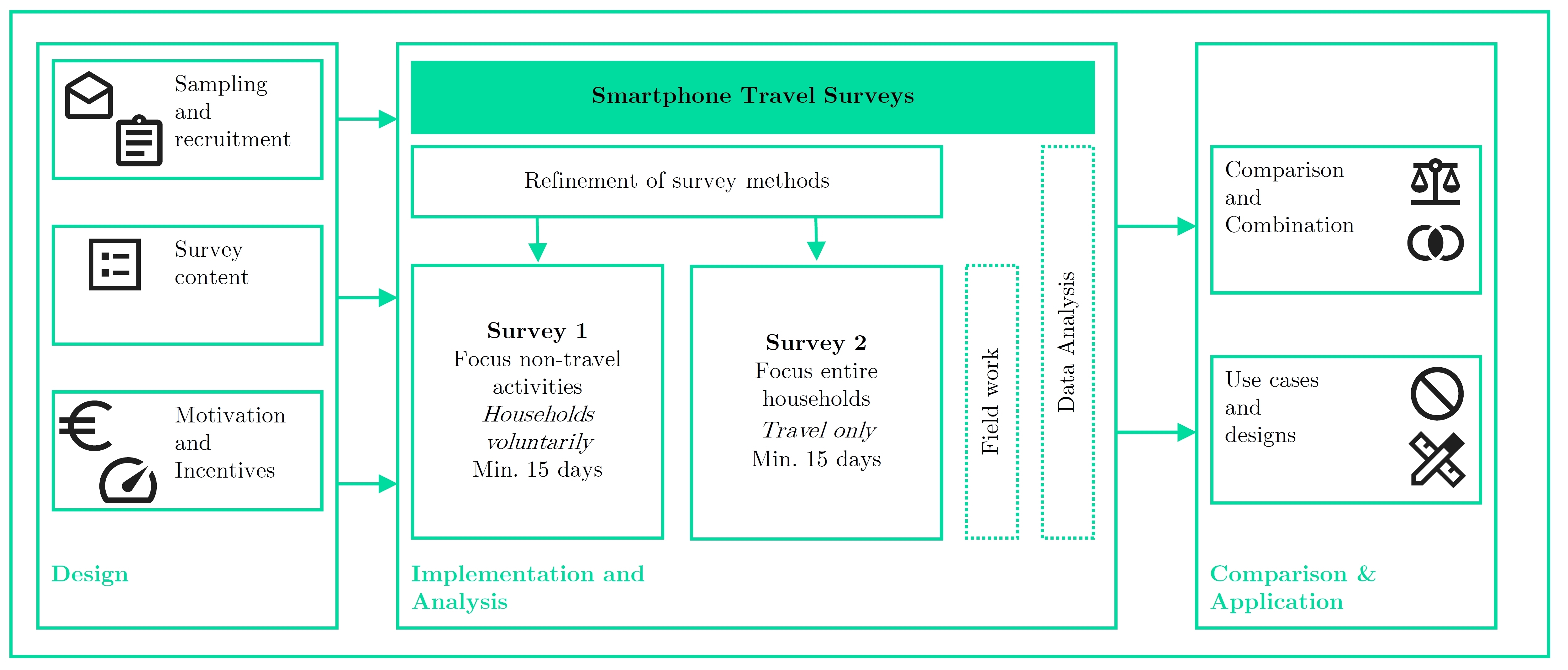
Project A1 enhances smartphone-based survey methods. We conduct modular longitudinal smartphone travel surveys, covering travel and non-travel activities, and aiming for entire household coverage. Survey methods are systematically varied as a basis for studying their effects. Based on these insights, we will develop use cases and designs for future travel surveys.
PI: Prof. Regine Gerike Team members: Dr. Stefan Hubrich, Johannes Weber, Manuel Diaz-Cordero, Ellen Glocar
A1
Project figure A1; Own illustration; Google Material Symbols, licensed under the Apache License, Version 2.0
A2
New methods for investigating stated behavior and preferences for extreme carbon reduction strategies
Project A2 aims to develop Stated Preference (SP) survey methods that provide reliable estimates of behavioral responses to extreme measures such as high carbon prices or street closures. We will conduct a large dynamic context-sensitive SP survey to investigate the effects of extreme transportation policy scenarios on activity participation and modal shares, to identify critical thresholds for behavior change (tipping points), and to provide empirical evidence on the corresponding elasticities. We will also conduct a pilot study to test gamification methods to explore user preferences and behavior.
PI: Prof. Hanna Hottenrott, Dr. Mohamed Abouelela Team members: Filippos Adamidis, Martin Castellanos-Gonzalez, Pushya Shree
A2
A3
New data on street design and street user activities for innovative safety assessment methods
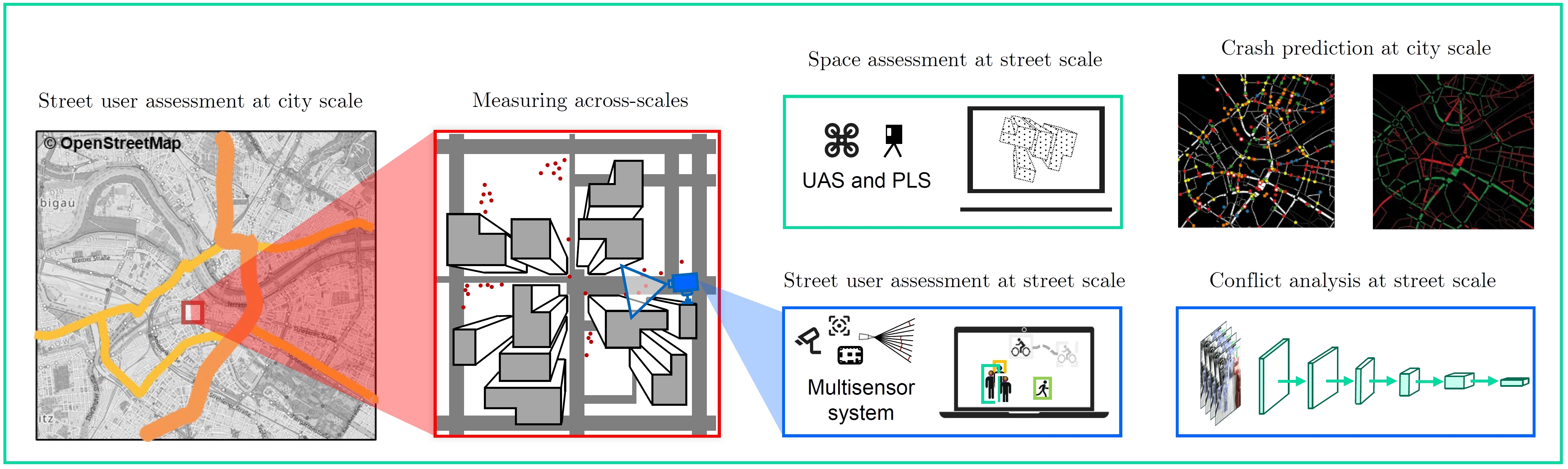
Project A3 will develop methods for mapping Vulnerable Road Users (VRUs) at the city scale based on aerial and Very High Resolution (VHR) satellite images. At the local street scale, we will prepare a multi-sensor system to anonymously map VRUs, and advance photogrammetric approaches to process multimodal 2D and 3D data to map street user environments. Based on pedestrian exposure data resulting from this process, other modes' volumes obtained from related projects, and openly accessible data on relevant variables, we will develop city-scale crash prediction models to assess how street characteristics and usage affect road traffic safety levels. In situations where crash data are limited, conflict analysis can complement traffic safety assessments. This project involves an innovative combination of numerical data (e.g., surrogate safety measures and street users' movement characteristics) and video-based observations to develop street-scale models for estimating the severity of traffic conflicts, with a particular focus on VRUs, through a highly automated process.
PI: Prof. Regine Gerike, Jun.-Prof. Anette Eltner Team members: Prof. Melanie Elias, Dr. Sebastian Hantschel, Paul Hindorf, Elham Golpayegani
Data analytics for characterizing and modeling travel and traffic patterns
The focus of A4 is on data science methods, which we apply and advance for different data types. First, hybrid techniques will be developed for generating an aggregate Origin-Destination (OD) travel demand based on high-frequency car travel time data. Second, cluster and classification algorithms will be developed to identify patterns in bicycle traffic using floating bicycle data. Third, we will develop methods to deal with overlaps in the coverage of data. Fourth, we will investigate intra-personal travel routines including the effects of intra-household interactions.
PI: Prof. Pascal Kerschke, Prof. Rico Wittwer Team members: Sebastian Dengel, Jonas Wübbenhorst, Jonathan Heins
A4
A6
Advancing agent-based transportation models to better represent active mobility
Project A6 will focus on improving transportation models to incorporate bicycling and walking more realistically. We will develop a portable process to create feature-rich multimodal networks that include relevant attributes for the active modes. We will incorporate and extend previous work on bicycle routing, utility evaluation, and interaction with motorized transportation into a comprehensive active-mobility modeling suite as an extension of MATSim and a critical component of the AgiMo Digital Twin. We will investigate how the newly developed methods can be adopted for walking in terms of multi-stage trips and create intuitive accessibility maps as a means to assess policy effectiveness.
PI: Dr. Dominic Ziemke Team members: Simon Metzler
A6
A7
Reinforcement learning for mode choice decisions
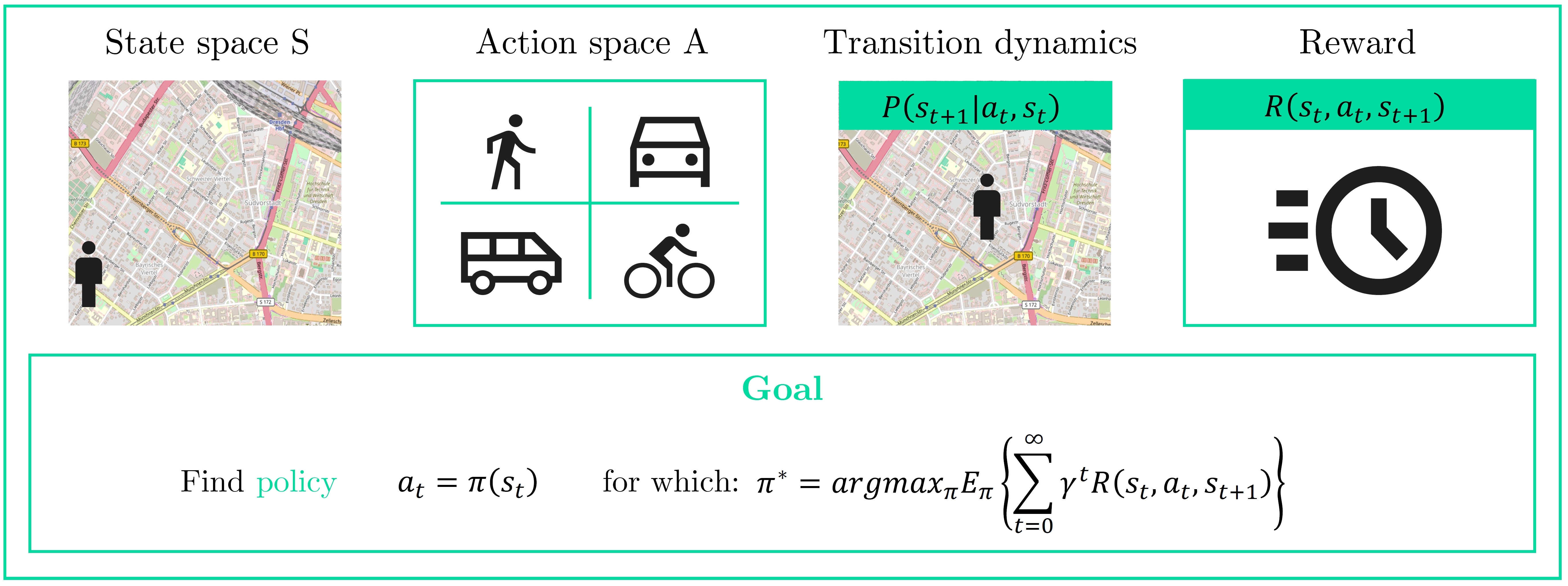
Project A7 seeks to explore the potential of Deep Reinforcement Learning (DRL) to develop models that handle dynamic mode choices, especially in scenarios with numerous and continuously changing alternatives. It also aims to investigate dynamic decision-making, where agents adapt as they move throughout the day, rather than planning all choices in advance. We will investigate how well a DRL agent can learn to make effective mode choice decisions compared to existing models, what initial strategies the agent develops in the MATSim environment, and how these strategies can be refined to produce more realistic decisions.
PI: Prof. Ostap Okhrin Team members: Ankit Anil Chaudhari, Ali Abbas Kapadia