RA B will focus on transportation systems and mobility services, and on methods for analyzing, simulating, planning and managing these systems. RA B will focus on road transportation, where the identified research gaps in planning methods include the active modes, integrated line-based and demand-responsive public transportation with autonomous vehicles, cooperative and adaptive traffic management strategies, city logistics and tradable travel credit schemes. Projects in RA B will collect and analyze data on pedestrians’ and cyclists’ on-street behavior, on multimodal traffic patterns in the context of cooperative and adaptive traffic signal control schemes, and on the behavior of all types of street users in shared space contexts. Based on this empirical evidence, street designs will be developed with a focus on pedestrians and place users, for whom the street is the destination, and who carry out their activities directly in the street space. Simulation methods will be developed for cyclists and shared space contexts and, on this basis, street designs will be proposed that better meet the street users’ needs. Cooperative and adaptive traffic signal control approaches for single intersections and corridors will be developed to accommodate the frequent arrival of Autonomous Mobility-On-Demand (AMOD) vehicles. Methods for modeling and enhancing mobility services will be developed, including integrated line-based and on-demand public transportation services, city logistics and MobilityCoins as a monetary incentive scheme complementing actual changes in systems and services.
B
B1
Human-centered adaptive street design for livable cities
Project B1 aims to develop methods for evidence-based human-centered street designs. We will advance spatial analysis methods to define generic street types of the urban street network. We will then spatially analyze the design and usage of selected street samples of different generic street types in the AgiMo study regions. We will advance user-centered experiments and technologies to explore street user preferences in the existing physical space, remodeled physical spaces in a lab environment, and virtual representations of spaces in immersive environments. The developed street designs will be evaluated with the 4F-principle framework.
PI: Prof. Vanessa Carlow Team members: Olaf Mumm, Dr. Deepank Verma, Bhupender Bindal, Ryan Zeringue
B1
B2
Analysis of bicycle flow characteristics based on different vehicle types and riders
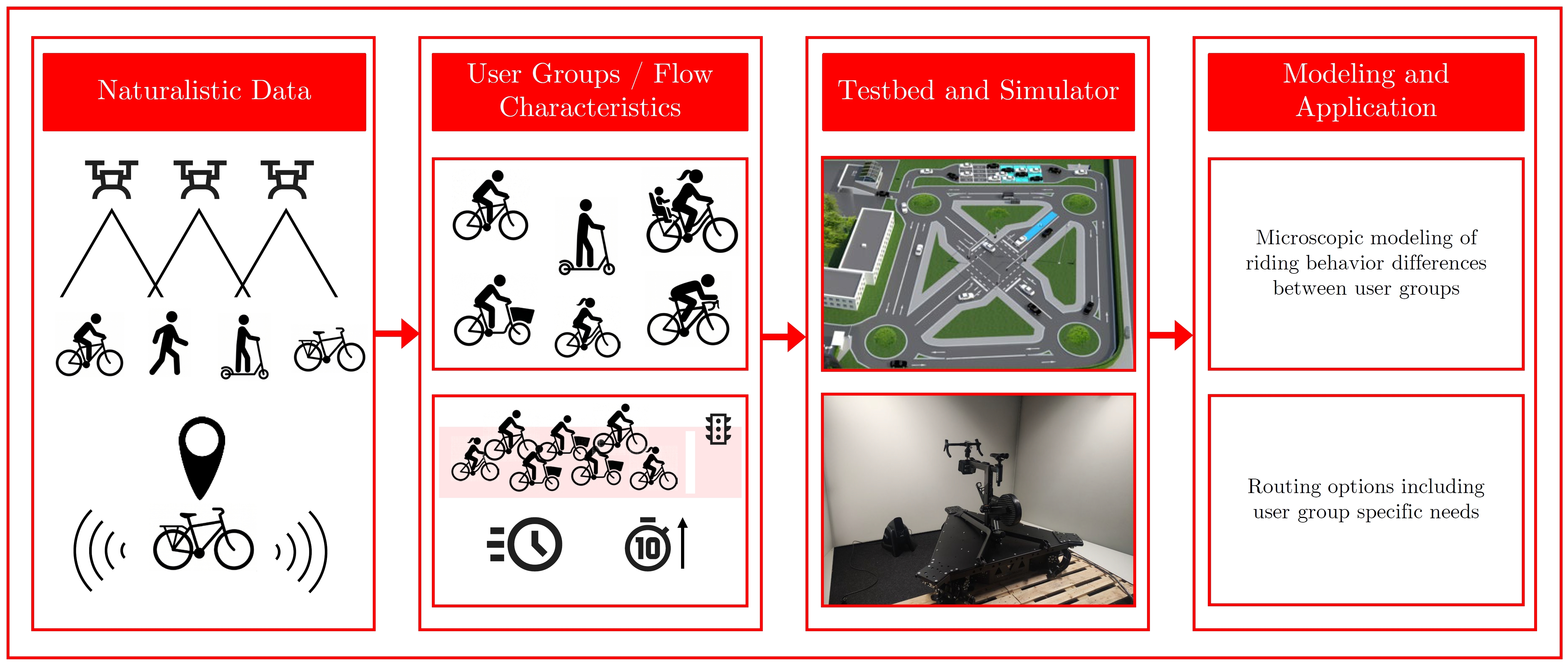
Project B2 aims at advancing methods for empirically investigating and simulating bicycle traffic. First, heterogeneous bicycle flow characteristics will be analyzed in real traffic conditions using data from aerial drones and from test rides with a sensor bike. Controlled experiments at the TUM Mobility Innovation Campus will be implemented, followed by experiments with micromobility simulators such as a bicycle, an e-scooter, and a cargo bike simulator. Based on this data, we will set up a microscopic bicycle simulation model with user-specific calibrated parameters to reflect the heterogeneity of cyclists in real-world conditions.
PI: Dr. Lisa Kessler Team members: Alexander Schöckel
B2
Project figure B2; Own illustration. Photos: Chair of Traffic Engineering and Control, TUM; Bicycle Icons generated by Google GeminiGoogle Material Symbols, licensed under the Apache License, Version 2.0
B3
Planning new public transportation services based on autonomous vehicles
Project B3 aims at developing new methods for jointly planning line-based and on-demand Public Transportation (PT) services, assuming a fully autonomous vehicle fleet. Analytical models and simulations will be used to identify the application boundaries of the different service types. The PT planning problem will be formalized mathematically, considering constraints such as the use of existing (rail-based) infrastructure. We will also test heuristic methods. The new planning methods will be linked with the AgiMo digital twin to consider interactions between service schemes and demand.
PI: Dr. Florian Dandl Team members: Hoda Hamdy
B3
B4
Multiobjective optimization of traffic signals for multimodal traffic
Project B4 will develop a cooperative and adaptive traffic signal control approach for single intersections and corridors to accommodate the frequent arrival of Autonomous Mobility-On-Demand (AMOD) vehicles. The developed approach should address the needs of buses, AMOD vehicles, private cars, cyclists and pedestrians and optimize multicriteria involving passenger delays, traffic efficiency, environmental effects and equity among others, so that finally, the potential of connectivity and autonomy of AMOD vehicles can be leveraged while at the same time mitigating the potential negativity of a large AMOD vehicle fleet.
PI: Prof. Meng Wang Team members: Dr. Menglin Yang, Dr. Chaopeng Tan, Qiongdan Hu
B4
B5
Design, operation and incentivation of two-echelon city logistics systems
Project B5 will develop an algorithmic framework for the design and operation of two-echelon city logistics systems (2eCLS), in which the operator can either directly transport goods to customers via trucks, or use micro-hubs. The new framework will augment combinatorial optimization with machine learning to obtain high-quality solutions for large-scale scenarios while being computationally fast. The framework will account for a multitude of credit and zoning schemes, and it will incorporate a nuanced cost approximation, including uncertainties, into strategic planning. The developed algorithms will be integrated into the AgiMo digital twin.
PI: Prof. Maximilian Schiffer Team members: Dr. Carolin Schmidt, Baptiste Vert
B5
B6
MobilityCoins for the management of multi-modal urban transportation and delivery systems
Project B6 will investigate MobilityCoins as a variant of Tradable Mobility Credits (TMC) for managing urban commercial transport, particularly for deliveries to private consumers. We will develop a MobilityCoin market design including core system parameters and boundaries. The new MobilityCoin market and a related logistics module will then be integrated into the AgiMo digital twin. Further, a web-based game will be developed where players simulate consumer choices (online vs. in-store) in response to the collective market dynamics, which will also be integrated into the AgiMo digital twin.
PI: Prof. Klaus Bogenberger, Prof. Hanna Hottenrott Team members: Dr. Anke Ye, Philipp Servatius
B6
B7
New methods for multi-modal microscopic simulation of street users’ behavior in shared space contexts
Project B7 will further develop the Intelligent Agent Model (IAM) so that it can be used to model complex multi-origin, multi-destination flows of non-lane-based agents including all street user groups. We will incorporate principles from social force models into the existing IAM model, and calibrate and validate it using both naturalistic and experimental data. The final model will then be able to simulate complex urban environments, including intersections and novel shared space concepts. The data for calibration and validation will be obtained from naturalistic datasets and experiments at the TUM Mobility Innovation Campus.
PI: Prof. Klaus Bogenberger, Dr. Martin Treiber Team members: Satish Kumar, Patrick Malcolm, Athanasia Karalakou